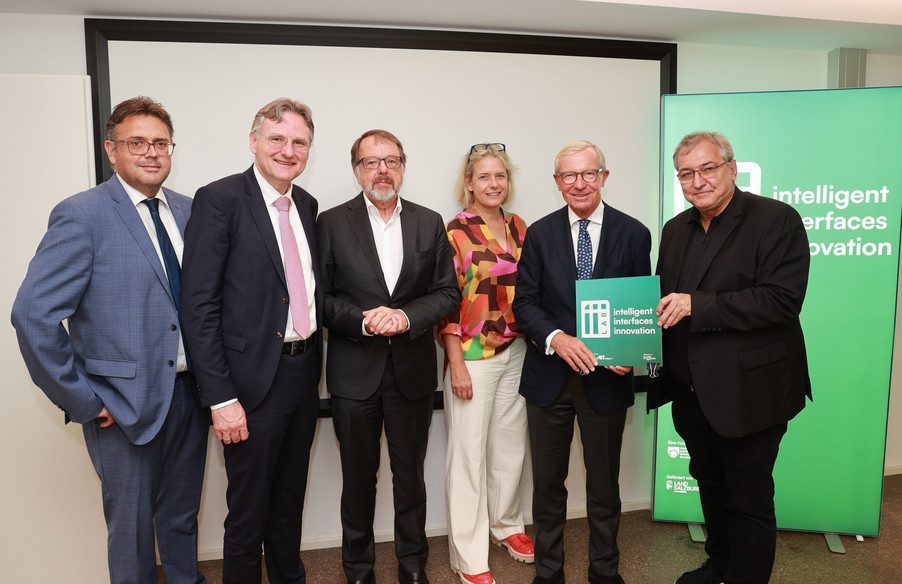
Artificial Intelligence, Virtual Reality, Mobile Work, and digitization in all aspects of life—the technological development is advancing rapidly, raising many questions along the way. This includes considerations on how people use computers, which technologies can be leveraged well and even better in the future, the experiences individuals have in utilizing new technologies, and how future technologies should be designed to benefit society and industry. The new III.Lab will address these questions and build upon the previous research of the Institute for Human-Computer Interaction (HCI) at the University of Salzburg. To achieve this, HCI is collaborating with the Austrian Institute for Technology (AIT)—Austria’s largest non-university research institution. Both teams, totaling around 70 employees in Vienna and Salzburg, are led by Manfred Tscheligi. He is a Professor of Human-Computer Interaction, heading the Department of Artificial Intelligence and Human Interfaces at PLUS. Simultaneously, since 2017, he has been the Head of the Center for Technology Experience at AIT. Tscheligi is recognized as an HCI pioneer in Austria—in research and education, as well as in industrial applications.
AIT brings expertise, personnel, and a significant portion of the funding, which is currently set for five years and supported by AIT (3 million euros), the University of Salzburg (1 million euros), and the state of Salzburg (1 million euros). Governor Wilfried Haslauer is convinced of the investment: “The rapidly advancing digital transformation in all areas of life and business, as well as the high dynamics in technological development, are of utmost importance for societal and economic developments, as well as for the future competitiveness of regions and locations in an increasingly knowledge-based economy. With the Intelligent Interfaces Innovation Lab, we are further expanding our federal state as a strong digital competence location.” This investment aligns with the science and innovation strategy of the state of Salzburg, where the digital location of Salzburg is anchored. The lab is also a notable addition to the Faculty of Digital and Analytical Sciences at the University of Salzburg.
What do the 3 i’s stand for?
- Intelligent: The first “I” stands for the development of future interaction forms. Machines and computers are “intelligent” partners for humans. Artificial intelligence must serve humans and not the other way around (Keyword: Human-Centered Artificial Intelligence).
- Interfaces: The second “I” stands for good, optimally usable user interfaces and future forms of interaction (the part of the technology that users interact with). The diversity of users also plays a crucial role. Technological developments enable new forms of interaction.
- Innovation: The third “I” stands for the use of innovative interdisciplinary methods and experimental implementations, application-oriented innovations, and the development of future-proof solutions.
In combination, it represents an interdisciplinary and important topic for the future. Walter Haas, Managing Director of Innovation Salzburg, is also convinced: “The interaction between people and technology has become commonplace for us since smartphones. It works intuitively and simply in this context. However, technological possibilities are becoming increasingly extensive, such as in industrial automation with AI support, autonomous driving, and much more that we may not even be able to imagine yet. The III.Lab deals with how we, as non-programmers, can handle such complex technologies. The Salzburg location once again demonstrates with this lab that here, the future is being thought of and shaped.
This might also interest you
28. May 2026
Joint Research Leads to Patent Application
An important milestone for Salzburg as a research and innovation hub: Salzburg University of Applied Sciences and ABB’s Machine Automation Division (B&R) have jointly filed a patent application in the field of AI-based energy efficiency.
21. May 2026
The Future of Microchip Manufacturing Comes to Salzburg
With the opening of a new competence center for so-called panel-level packaging, Lam Research is sending a strong signal for Salzburg as a technology and research hub.
15. April 2026
From AI to energy: Four Salzburg companies recognised
In 2026, the Salzburg Innovation Award was presented for the first time, introducing a new distinction for particularly innovative companies in the region. The four awarded projects highlight the diversity of innovation in Salzburg – ranging from satellite data and artificial intelligence to recycling technologies and digital energy infrastructure.
12. March 2026
SALZ 2026: Innovation and Technology in Focus – Startups, AI and Future Markets in Salzburg
The SALZ – Festival for Innovation & Technology brought together companies, startups, research institutions and public stakeholders at Messe Salzburg on 11 March 2026. With keynotes, panels, matchmaking and startup pitches, the event provided a platform for emerging technology trends, new collaborations and exchange within the innovation ecosystem.